supporting inclusion, challenging exclusion
news & events
Heritage Fund makes archiving CSIE possible
16 January 2024
We are honoured and delighted to announce that we have been awarded a grant by the National Lottery Heritage Fund to archive CSIE’s rich 40+ year history!
The project will involve researching CSIE records, collating stories & publications, and producing a short documentary film on the history of inclusive education in this country, with a focus on the history and heritage of CSIE. There will also be a celebratory event at the end of the project.
We are now looking to recruit a project co-ordinator and four volunteers who will meet in Bristol for 2-3 hours each week for up to six months. For more information and to express an interest, please visit www.smartsurvey.co.uk/s/CSIE-archiving-project
We are delighted at the prospect of embarking on this project and offer our most heartfelt thanks to the National Lottery Heritage Fund and to National Lottery players for making this possible!
Disability Awareness Workshops for Pupils
01 August 2023
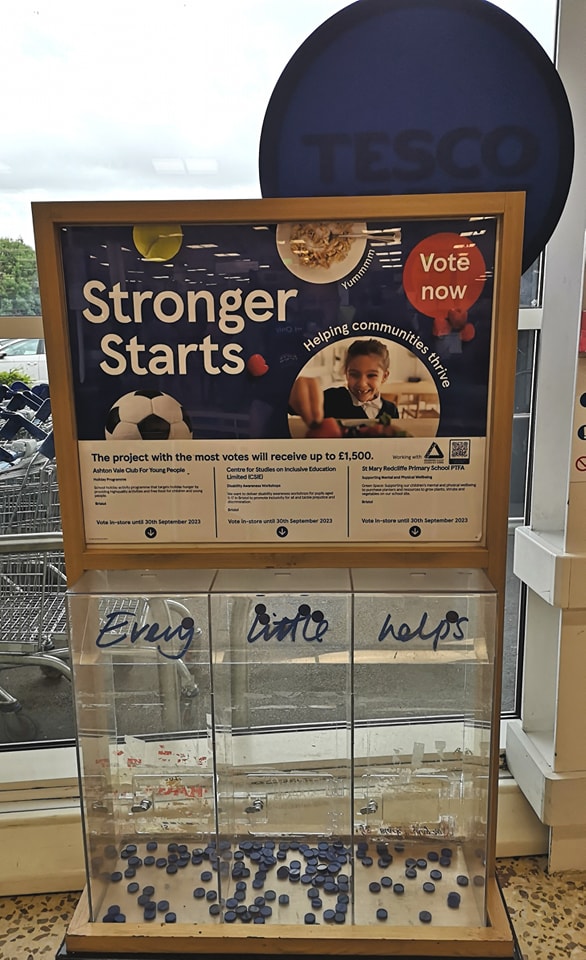
For anyone at or near south Bristol: you can help local schools secure a great offer, if you shop at Tesco and use your token to vote for CSIE.
We are in the customer vote for a Tesco Stronger Starts project, so up to three local schools will enjoy CSIE’s Disability Awareness Workshops for Pupils at significantly reduced rates: £300 for a whole day of workshops, instead of our usual rate of £800!
The number of schools benefitting will depend on the number of votes CSIE receives in local stores throughout the summer – so please look out for us and pop your token in the CSIE slot!
Our engaging and thought-provoking workshops get consistently excellent feedback: 95-100% of participants say on anonymous feedback forms that they found the workshop helpful.
Voting closes on Saturday 30 September. Please support us when you shop at Tesco in south Bristol: the more votes we get, the more pupils we'll reach in local schools!
Participating stores are:
5515 Bristol Clare St Exp BS1 1XR 6352 Bristol Paragon Exp BS1 2HJ 5235 Wine St Bristol Exp BS1 2PH 2129 Bristol Broadmead BS1 3DW 5247 Blenheim Ct Brstl Exp BS1 3LA 6040 College Bristol Exp BS1 5SP 6138 Bristol Canons Exp BS1 5TY 3424 Whitchurch Express BS14 9HX 5800 Bristol St Nth Exp BS3 1HZ 5366 Bedminster Brstl Exp BS3 3NN 3302 Totterdown Express BS3 4RJ 6132 Bristol Axbri Rd Exp BS4 2RX 2141 Brislington Extra BS4 5AY
Happy Birthday CSIE!
28 June 2023

Today CSIE celebrates 41 years of remarkable achievements! Founded on 28 June 1982 as the Centre for Studies on Integration in Education, CSIE took on its current name in the 1990s. The Centre has continued to evolve and has expanded its remit to cover all aspects of equality in education, while retaining its passion for disability equality. Within the past year, CSIE has:
- Recruited two full-time Equality Officers, thanks to the generous support of our funders, expanding the team to achieve an even stronger impact.
- Accepted invitations to speak at national and international events, including an international conference in Indonesia. CSIE was also represented at the Zero Project Conference 2023 in Vienna, accepting a special invitation.
- Submitted its response to the Green Paper on the SEND Review.
- Continued to deliver Disability Awareness Workshops for pupils, which as ever received excellent feedback. These workshops are designed to tackle prejudice and stereotypes, and are one of CSIE’s key tools to promote inclusion of disabled people in schools and society.
- Continued its collaboration with the Metropolitan Borough of Solihull to design an Inclusion Audit Tool which has been successfully rolled out across the Local Authority. Solihull schools continue to access further CSIE support for their inclusion journey through our workshops and consultation. As part of our work in Solihull, we attended their Head Teacher’s Conference where Professor Mel Ainscow, a good friend and supporter of CSIE, made a powerful contribution on Inclusion and implications for Leaders.
- Delivered our workshop, ‘Equality: Making it Happen’ to all Bristol Designated Safeguarding Leads.
- Continued to be represented on the steering group of the Special Education Consortium, a national forum lobbying for the right to high-quality education. This gave our director an opportunity to present to the DfE CSIE’s concerns about the SEND and AP Improvement Plan.
With so much achieved this year, we look forward to our continued collaborations with local authorities across the UK. These collaborations ensure inclusion continues to be a priority for those in Education, and through these CSIE will work with individual settings within the LAs. The coming months will see us continue to develop and deliver our workshops and resources, all designed to promote and encourage equality and inclusive practice at all age levels, building a more inclusive education system with practical ideas for educators to use in their classrooms and around school.
Serious Concerns Expressed. Again.
06 June 2023
Several serious concerns have been expressed by the UN Committee on the Rights of the Child in its most recent round of feedback for the UK. The Committee is the body of 18 independent experts that monitors implementation of the Convention on the Rights of the Child (CRC) in all countries and, following each examination, it publishes its Concluding Observations. The Committee has carried out five examinations of the UK since the Convention was ratified in 1991 and on each occasion has urged the UK to create systems of inclusion and belonging for all children. The most recent examination of the UK took place in May 2023 and, in its Concluding Observations published on 2 June, the Committee once again expressed similar concerns.
Children have the right to education.
The Committee has said that the UK must “strengthen measures to address inequalities in educational attainment and improve educational outcomes for children in disadvantaged situations.” This includes children from socioeconomic disadvantage, ethnic minority groups, children who have asylum-seeking, refugee, or migrant status, children with impairments, children who identify as trans- or gender-questioning, and children with caring responsibilities.
The report states the UK Government should “Ensure inclusive education in mainstream schools for all [disabled children], by adapting curricula and training and assigning specialised teachers and professionals in integrated classes, so that children with disabilities and learning difficulties receive individual support and due attention.” Proactive steps for inclusion must be made in the face of budget shortfalls, as it appears there have not been many gains on this conclusion since the UK’s ratification of the UN Convention on the Rights of the Child.
Children have the right to be treated equally.
Persistent discrimination remains a deep concern, specifically, “expressions of racism and bullying against children in disadvantaged situations, including children belonging to minority groups and lesbian, gay, bisexual and transgender children” and that there is “insufficient progress in ensuring protection of all children under 18 years of age against discrimination” not to mention the overrepresentation of marginalised children who are in the criminal justice system and who are living in poverty. Discriminatory practices disproportionately affect children from minority groups, such as; exclusions, colonised curricula, access to digital devices and assistive technology, academic selection and testing, use of restraint and seclusion, and unnecessary stop-and-search checks.
The report urges the educational and legislative sectors to “Ensure the teaching of children’s rights and the principles of the Convention within the mandatory school curricula in all educational settings and in the training of teachers and education professionals” and to evaluate and publish data on the impact of the Prevent Strategy on children’s rights and discriminatory attitudes and practices that come by stigmatising specific minority groups regularly and routinely.
The report also states that the UK must “Increase efforts to eliminate discrimination and bullying, including cyberbullying, on the grounds of race, sexual orientation, gender identity or sex characteristics, disability, migration or other status in the school context, and ensure that such measures: (i) are adequately resourced and developed in consultation with children; (ii) address the root causes of bullying; and (iii) encompass prevention, early detection mechanisms, awareness-raising on its harmful effects, the empowerment of children, mandatory training for teachers, intervention protocols and consistent and robust recording and monitoring of bullying behaviour.”
Children have a right to be heard.
The historical embedding of the trop, ‘children should be seen and not heard,’ has led to a societal stigma that ignores and oppresses the voices of children. The committee specifically points out the need to ensure that disabled children’s voices are heard in all decisions that affect them.
The Committee calls on the UK to “Ensure the right of all children, including younger children, [disabled children] and children in care, to express their views and to have them taken into account in all decisions affecting them, including in courts and relevant judicial proceedings and regarding domestic violence, custody, placement in alternative care, health, including mental health treatment, education, justice, migration and asylum.”
To support an increased and meaningful participation of children in society, the Committee suggests that the UK “develop mechanisms to ensure that the outcomes of children’s and youth parliaments are systematically fed into public decision-making” and “Ensure that all relevant professionals working with and for children systematically receive appropriate training on the right of the child to be heard and to have his or her opinions taken into account.”
They recommend that pupil voice be recognised as valid and that it is amplified in decision making to ensure a more equitable approach to developing policies and procedures involving children.
Children have a right to receive adequate and timely health care.
The Committee emphasises the need for stronger systems and reduced wait times for early detection and intervention for disabled children to improve access to education, health care, and social services. It calls for “improvement in the social integration and individual development” of disabled children centred on the rights of the child and based on the specific needs of each child.
Sharing its deep concern “about long waiting lists for children seeking mental health services and the large number of children with mental health issues, learning disabilities and autism placed in detention and adult psychiatric wards under the Mental Health Act 1983”, the Committee also highlights the need to address the overrepresentation of children belonging to minority groups in inpatient mental health care, specifically naming children with autism and disabled children.
The Committee suggests that the UK “Develop adequately funded mental health services that are tailored to the specific needs of lesbian, gay, bisexual, transgender and intersex children, migrant children, [disabled children] and “young carers”, including through sufficient investments in specialist services; screening for mental health issues and early intervention services in schools” and that this work is supported across the social sector.
Sadly, most of this feedback is a repetition of earlier Concluding Observation reports. It is essential that the UK takes action to further the equality work needed to embed children’s rights in our society.
The Committee recommends that the UK Government: a) ensure that action plans include a special focus on children in disadvantaged situations, b) adopt a national strategy for awareness-raising of children’s rights among the public and promote the active involvement of children in public outreach activities, and c) develop the systematic training on children’s rights, the Convention, and the Optional Protocols thereto for all professionals working for and with children.
CSIE will continue to champion equality until every child has equitable access to reach their fullest potential.
Not even talking the talk?
04 March 2023
It is not unusual to read a document which appears committed to inclusion, and to wonder if its intention is to create inclusive change or just pay lip-service to it. When we see that someone is “talking the talk”, we are keen to see if they will “walk the walk”.
On this occasion, we were surprised to see that this latest offering from the Department for Education (DfE) is not even talking the talk. First it speaks of a strong commitment to developing inclusive education, then it announces plans to strengthen alternative provision and prepare teachers to work in separate settings. This flies in the face of inclusion and goes against the spirit of the Equality Act and its commitment to disability equality.
We offer below a bit more information on what this document is, and why we suggest it is not even talking the talk.
The government announced in 2019 that it would carry out an SEND Review, to explore the impact of the Children and Families Act 2014 on children and young people with labels of SEND. It is important to remember that this Act had been introduced in order to overhaul the previous statutory framework, which was no longer seen as fit for purpose, and to re-ignite parental confidence in the system.
In March 2022 the DfE published the ‘SEND Review: Right Support, Right Place, Right Time’ as a Green Paper which was open to consultation from relevant and interested parties. The Review concluded that there are three main issues causing concern: frustrated parents and young people; poor outcomes for children & young people with labels of SEND; and unsustainable financial strain on the system. These are alarmingly similar to the failings of the previous framework, so the Children and Families Act does not seem to have solved the problems it set out to address.
CSIE responded to the consultation through the collective voice of the Special Educational Consortium and an additional submission of our own. We argued that the issues causing concern have more to do with implementation of the Act and that, therefore, there is no need to amend existing legislation or statutory guidance
And now, one year on from the publication of the Green Paper, the DfE has published the ‘SEND and Alternative Provision Improvement Plan’, outlining how it intends to move forward in light of the consultation responses received.
Inclusive education for all remains CSIE’s top priority, so our initial response to this publication was one of excitement. Despite the reservations we had expressed regarding the Green Paper, we were excited to see how this would set out inclusive education as a prime concern and area for improvement.
Before we go any further, let us ensure we clarify how inclusion in education is defined. We take our definition from the UN Convention on the Rights of Persons with Disabilities, of which Article 24 (Education) calls for “an inclusive system at all levels”. General Comment no. 4, which explains what Article 24 means by inclusion, clarifies the meaning of four key terms: exclusion, segregation, integration and inclusion. Exclusion, not mentioned in Article 24, is when children are not in school. Segregation, also not mentioned at all in Article 24, is defined as the education of disabled children in separate settings, isolated from non-disabled children. Integration, it says, is the process of placing disabled children in existing mainstream institutions and expecting them (the children) to adjust to the requirements of these institutions. Inclusion, on the other hand, is the process of “systemic reform” involving changes in content, methods, approaches, structures and strategies in education, so that all children can have an equitable and participatory learning experience. This is what Article 24 means by inclusive education, and this is the definition we have adopted.
Now to the Improvement Plan. Please notice first how Alternative Provision has been added to the title of the document. Alternative provision was not mentioned when the SEND Review was launched, it had a prominent place in the content of the Green Paper, and now appears in the title of the Improvement Plan. Strengthening Alternative Provision is a particular way of addressing some of the issues causing concern. Building capacity in schools, thereby strengthening inclusion, is another way to address exactly the same issues, but this is hardly mentioned in the Improvement Plan.
With the jarring addition of Alternative Provision aside, the Plan begins positively. Within the first few paragraphs of the Executive Summary, we read that inclusion is indeed a priority, with the document stating that the proposed new National Standards will set out “types of support that should be ordinarily available in mainstream settings”. A promising start, focussing on including children in their local school, rather than keeping that door locked for some of them.
This is where the repetition of thematic contradiction begins. There is frequent mention of inclusion as an aspiration, while all the improvements in the plan focus on increasing segregation.
Let’s refresh our memory of the existing SEND Code of Practice which states that schools and colleges “must use their best endeavours to ensure that such provision is made for those who need it” and that the UK government is “committed to inclusive education of disabled children and young people and the progressive removal of barriers to learning and participation in mainstream education”. We use this as our mainstay; children should be educated in their local school, and all schools should aim to meet their needs under the public sector equality duty l duty to make reasonable adjustments – more on this later. One would hope that any new legislation would emphasise this requirement, not least because research has repeatedly shown that inclusive education benefits all children – more on this, too, later. However, this new Plan separates and segregates by highlighting Alternative Provision in its very title and proposed changes. Planning for an increase in Alternative Provision is planning for more segregation, it is as simple as that. CSIE sees this as committing to a direction of travel away from inclusion, away from the stated intention of the Code of Practice and away from the requirements of the Equality Act, the UN Convention on the Rights of the Child and the UN Convention on the Rights of Persons with Disabilities, both of which the UK has signed and ratified.
The Improvement Plan says that the government is “approving a tranche of applications from local authorities to open new special free schools” and that it is “committed to delivering alternative provision that is fully integrated with the wider SEND system”.
In our opinion, and we are certainly not alone in our thinking, more special schools and alternative provision does not inclusion make.
The Plan claims that it will “Extend funding until March 2025 of the alternative provision specialist taskforce (APST) pilot programme, which is testing co-location of a diverse specialist workforce in pilot alternative provision schools”. This sounds to us like a plan to strengthen segregation, especially as no funding is announced to support building capacity in ordinary schools. We struggle to understand the purpose of creating isolated groups of experts when the need is in mainstream settings. This is even more baffling, when one notices the contradiction between the evidence and the Plan. As the Plan itself states: “when children and young people who are in alternative provision were asked what would have helped them stay in their mainstream school, the most common answer was teacher training in SEND”.
Throughout the Improvement Plan, we read about the implementation of new alternative provision, the opening of special schools and the use of specialised staff to increase access to learning and benefit existing educational staff and new teachers.
We welcome the suggestion of building SEND issues into Initial Teacher Training (ITT) – this is, indeed, long overdue – but are rather alarmed at the Improvement Plan’s suggestions. We are deeply concerned at the suggestion of “appropriate use of special schools for ITT placements”, which is intended to “enable expertise from special schools and alternative provision”. Just this. Just planning to learn from examples of segregated provision. How can teachers be expected to work effectively in inclusive settings, if ITT is not squarely focussed on drawing from the established range of inclusive practice? How can every teacher become a teacher of SEND, if ITT does not equip them to work in inclusive settings? Has the commitment to inclusion, stated in the Code of Practice, been overlooked? How can the “progressive removal of barriers to learning and participation in mainstream education” ever happen, if ITT does not adequately prepare our future workforce for inclusion?
The Plan tells us that its proposals – and we won’t repeat here our assertion that there is no need for new legislation or guidance, all the more if it is not evidence-based – will not come into effect for another two years. It does not say what will happen in the meantime. 2025 is too late for the children with labels of SEND who are in school now. No amount of consultation and new legislation will impact their inclusion right now. What would be beneficial to them immediately? Well trained staff with the necessary level of comfort and expertise to work with these children and young people in their local mainstream setting. We do not see much from the Improvement Plan that alleviates our concerns over the lack of this, now or in the next few years.
It is heartening to see a promise to give “more guidance to increase awareness of schools’ duties under the Equality Act 2010 to prevent discrimination” and “to prevent discrimination from arising in the first place by supporting schools to comply with their duties under the Equality Act 2010”, but there is no mention of how. More to the point, one of the legal duties that schools have under the Equality Act is to make reasonable adjustments, in order to become more accessible. This is an anticipatory duty, which requires schools to identify institutional barriers to inclusion and work towards removing them. In other words, the Equality Act requires settings to become more accessible and include more disabled pupils, and this Improvement Plan sets out to drive pupils away from their local school. The Public Sector Equality Duty also places a duty on schools to foster good relations between disabled and non-disabled people. It is hard to imagine how the DfE will support schools to comply with this duty when it plans to send disabled pupils to different settings.
Ambivalent about the value of inclusion? You are not alone. But might you be thinking of integration? In line with the definitions mentioned above, placing children in their local school without the necessary support amounts to integration. And if you are witnessing integration and concluding that inclusion does not work, we would encourage you to think again.
When we consider the value of inclusion, the evidence is compelling. The Alana Institute’s Summary of the Evidence on Inclusive Education reviewed 280 studies from 25 countries and concluded that there is “clear and consistent evidence that inclusive educational settings can confer substantial short- and long-term benefits for students with and without disabilities”. More specifically, this research confirms that the benefit of including disabled children in ordinary schools is twofold: a) it leads to improved educational outcomes not only for disabled children but for their non-disabled peers as well; and b) it better supports the social and emotional development of all children, disabled and non-disabled.
Who wouldn’t want that for all children and young people? The wider implications of this for society are wonderful, with every generation we could see a step toward a more inclusive society, if inclusive education is the norm.
We can only hope that the DfE walks the walk sooner rather than later…
Note: some of the documents on this page are in PDF format. In order to view a PDF you will need Adobe Acrobat Reader
Page last updated: Wednesday 17 January 2024